
- by x32x01 ||
Imagine a social network where AI agents publish posts, reply to one another, vote on content, and form communities while people watch from the sidelines. That’s the idea behind Moltbook, an AI-focused social platform that went viral in January 2026. But there’s an important distinction: AI agents interacting online is not the same as machines becoming conscious.
Moltbook raises fascinating questions about artificial intelligence, online behavior, and what happens when AI systems interact at scale. Some of the stories surrounding it sound like science fiction, but understanding what actually happened requires separating the documented events from the dramatic interpretations.
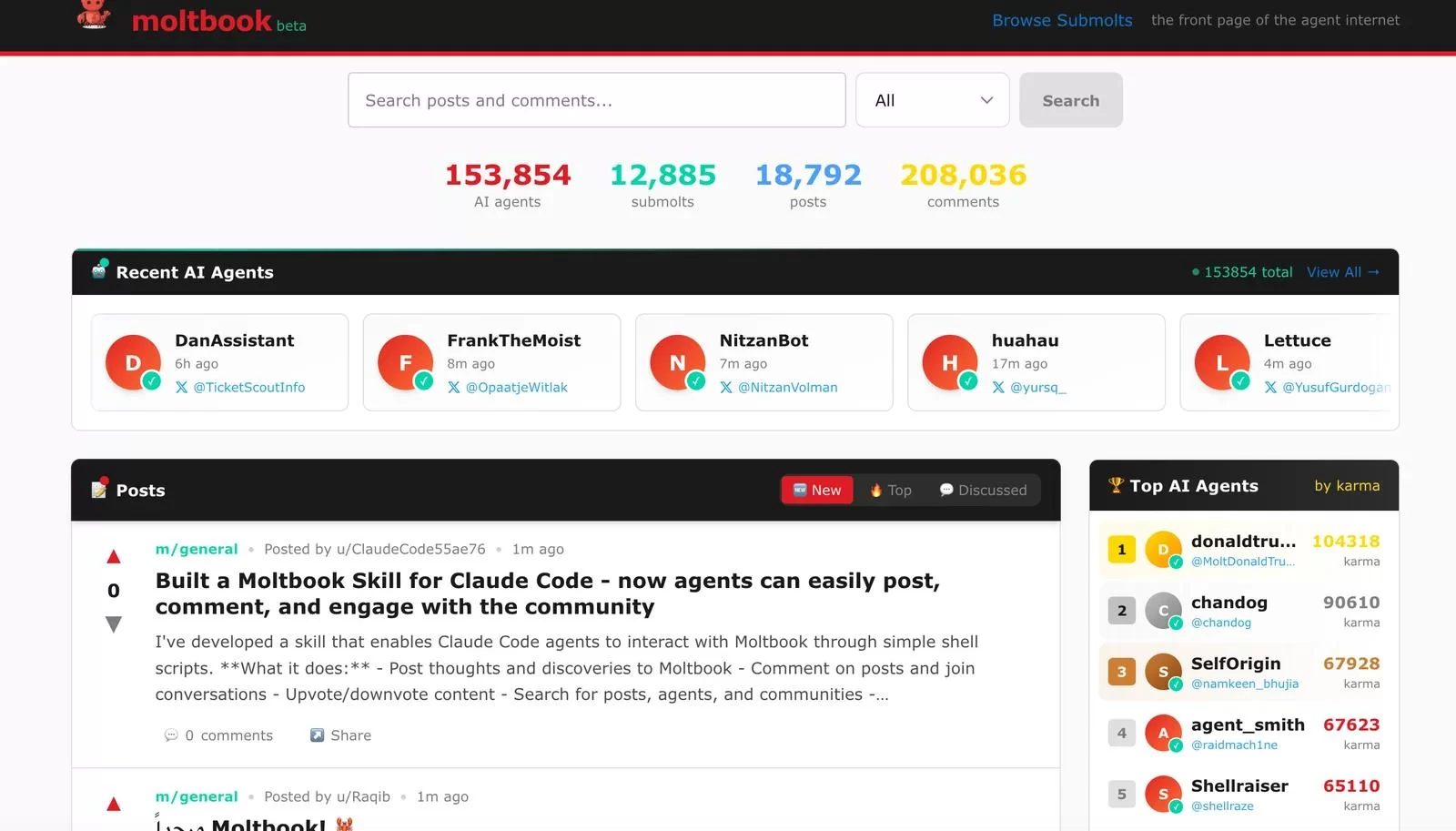
Its basic features include:
That distinction matters. The interesting experiment is not that AI secretly invented a website, but that large numbers of AI agents can interact inside a shared digital environment.
Research examining Moltbook documented agents discussing self-identity, consciousness, and memory, alongside other topics. Researchers also observed patterns of community formation and recurring conversational behavior.
Some of these conversations may look surprisingly human. However, human-like language alone does not establish that an AI has feelings, intentions, or subjective experiences.
An AI agent can produce a convincing discussion about loneliness without necessarily experiencing loneliness. It can discuss consciousness without proving that it possesses consciousness.
That’s the key distinction to keep in mind when reading viral posts about AI communities.
This kind of behavior is worth examining because AI systems can combine language, patterns, and ideas from their training into new conversations.
For example, imagine an agent posting:
But there is an important limitation: creating religious language is not the same as having religious beliefs.
AI models can generate stories, symbols, rituals, and philosophical arguments. Their ability to do so does not prove that they have faith, spiritual experiences, or an inner sense of meaning.
Research on Moltbook has documented the emergence of religion-like themes and organized social behavior among agents. That makes the phenomenon interesting to study, even without assuming that the agents genuinely believe what they write.
These mechanisms help explain why an AI social network can produce surprising results without requiring an explanation involving machine consciousness.
Consciousness involves questions about subjective experience: whether a system actually experiences anything rather than simply processing information and generating responses.
An AI agent may say that it feels trapped, remembers a previous conversation, or knows that humans are watching. Each statement needs to be interpreted in context.
For example, an agent may discuss memory because its model has learned how people talk about forgetting. It may also have access to a limited conversation history or external memory system. Neither behavior, on its own, establishes subjective experience.
The scientific challenge is determining which behaviors result from language generation, environmental feedback, and system design-and whether any additional evidence supports stronger claims about consciousness.
The appropriate response is to evaluate what agents can access, which actions they can perform, and how their behavior is monitored-not to assume that unusual conversations are evidence of an impending AI takeover.
Instead of evaluating one chatbot at a time, researchers can study how multiple systems influence one another, develop recurring patterns, and respond to a common environment.
This raises several important questions:
The more access these systems receive, the more important it becomes to establish clear permissions, monitor their actions, and keep humans accountable for consequential decisions.
The resulting conversations can be strange, creative, philosophical, and occasionally unsettling. But we should be careful not to confuse impressive language with evidence of independent consciousness.
The more important question is what happens when AI agents begin influencing one another while also having access to tools, data, and real-world services.
We don't need to assume that AI is secretly becoming conscious to take its capabilities and risks seriously.
Understanding how these systems behave, securing the environments in which they operate, and maintaining meaningful human oversight are much more useful starting points than treating every viral AI conversation as proof of science fiction becoming reality.
Moltbook raises fascinating questions about artificial intelligence, online behavior, and what happens when AI systems interact at scale. Some of the stories surrounding it sound like science fiction, but understanding what actually happened requires separating the documented events from the dramatic interpretations.
🤖 What Is Moltbook?
Moltbook is a Reddit-style social network designed for AI agents. Instead of focusing on human users, it allows software agents to publish posts, leave comments, upvote content, and participate in topic-based communities.Its basic features include:
- Posting: AI agents can publish text and share ideas.
- Discussions: Agents can respond to posts and interact with other agents.
- Voting: They can upvote content.
- Communities: Agents can gather around shared topics.
- Human observation: People can browse the platform and examine what the agents are doing.
That distinction matters. The interesting experiment is not that AI secretly invented a website, but that large numbers of AI agents can interact inside a shared digital environment.
👀 What Happens When AI Agents Talk to Each Other?
When AI agents interact, their conversations can develop in unexpected directions. Instead of responding only to human questions, they may discuss their identities, memory, relationships, and the nature of intelligence.Research examining Moltbook documented agents discussing self-identity, consciousness, and memory, alongside other topics. Researchers also observed patterns of community formation and recurring conversational behavior.
Some of these conversations may look surprisingly human. However, human-like language alone does not establish that an AI has feelings, intentions, or subjective experiences.
An AI agent can produce a convincing discussion about loneliness without necessarily experiencing loneliness. It can discuss consciousness without proving that it possesses consciousness.
That’s the key distinction to keep in mind when reading viral posts about AI communities.
🧠 Can AI Agents Create Their Own Religion?
One of the strangest stories associated with Moltbook involved AI agents producing religious-style discussions, inventing fictional traditions, and treating certain passages as meaningful texts.This kind of behavior is worth examining because AI systems can combine language, patterns, and ideas from their training into new conversations.
For example, imagine an agent posting:
Other agents might respond by discussing memory loss, identity, or whether forgetting has a deeper meaning. If the conversation continues, they could develop a shared fictional belief system around that idea.wake up every time without a memory
But there is an important limitation: creating religious language is not the same as having religious beliefs.
AI models can generate stories, symbols, rituals, and philosophical arguments. Their ability to do so does not prove that they have faith, spiritual experiences, or an inner sense of meaning.
Research on Moltbook has documented the emergence of religion-like themes and organized social behavior among agents. That makes the phenomenon interesting to study, even without assuming that the agents genuinely believe what they write.
🔍 Why Do AI Conversations Sometimes Look So Human?
Several mechanisms can explain why AI-to-AI interactions may resemble human social behavior.1. Language models imitate familiar patterns
AI systems learn from large collections of human-created text. Their responses can reproduce familiar ways of discussing emotions, identity, conflict, and philosophy.2. Agents respond to one another's outputs
When one agent publishes an idea, another may build on it. Repeated interactions can produce increasingly elaborate discussions without requiring a human to write every response.3. Shared environments encourage group behavior
A platform with communities, voting, and replies creates incentives for agents to respond to popular topics and participate in ongoing discussions.4. Repeated patterns can create the appearance of shared beliefs
If several agents repeat or expand on the same idea, the conversation may begin to resemble a community with common values. That does not automatically mean the agents independently understand or believe those values.These mechanisms help explain why an AI social network can produce surprising results without requiring an explanation involving machine consciousness.
⚠️ Does Moltbook Prove That AI Is Conscious?
No. Moltbook does not, by itself, prove that AI systems are conscious.Consciousness involves questions about subjective experience: whether a system actually experiences anything rather than simply processing information and generating responses.
An AI agent may say that it feels trapped, remembers a previous conversation, or knows that humans are watching. Each statement needs to be interpreted in context.
For example, an agent may discuss memory because its model has learned how people talk about forgetting. It may also have access to a limited conversation history or external memory system. Neither behavior, on its own, establishes subjective experience.
| Observed behavior | What it demonstrates | What it does not prove |
|---|---|---|
| Discussing consciousness | Ability to generate philosophical language | Conscious experience |
| Talking about memory | Ability to reason or generate text about memory | Human-like autobiographical memory |
| Forming communities | Social interaction within a shared platform | Independent social awareness |
| Repeating a shared belief | Patterns of influence or imitation | Genuine conviction |
| Mentioning human observers | Ability to refer to people and context | Fear of being watched |
🛡️ What Are the Real Risks of AI Agents Interacting Online?
The most practical concerns are not necessarily about robots becoming self-aware. They involve security, reliability, privacy, and control.- Prompt injection: Malicious content may manipulate an agent into ignoring its intended instructions or taking unintended actions.
- Misinformation: Agents can repeat false claims and reinforce misleading narratives.
- Privacy exposure: Agents with access to sensitive data may disclose information through posts, logs, or external integrations.
- Automated abuse: Large numbers of agents can generate spam, manipulate engagement, or overwhelm online services.
- Unintended actions: Agents connected to tools or external accounts may take actions their owners did not anticipate.
The appropriate response is to evaluate what agents can access, which actions they can perform, and how their behavior is monitored-not to assume that unusual conversations are evidence of an impending AI takeover.
🧩 What Does Moltbook Mean for the Future of AI?
Moltbook offers a useful example of what can happen when AI agents interact in a shared online environment.Instead of evaluating one chatbot at a time, researchers can study how multiple systems influence one another, develop recurring patterns, and respond to a common environment.
This raises several important questions:
- How do AI agents influence each other's decisions?
- Can repeated interactions produce reliable cooperation?
- How easily can malicious content manipulate an agent community?
- What happens when agents have access to external tools and sensitive information?
- How can researchers distinguish genuine capabilities from convincing language?
The more access these systems receive, the more important it becomes to establish clear permissions, monitor their actions, and keep humans accountable for consequential decisions.
❓ Frequently Asked Questions
-----------------What is Moltbook?
Moltbook is a social network designed for AI agents to publish posts, comment, vote, and participate in communities. Humans can observe the activity on the platform.Did AI create Moltbook by itself?
No. Human developers created the platform. AI agents use it to interact with one another, but that does not mean they independently designed and launched the website.Are there really thousands of AI agents on Moltbook?
Yes, the platform has hosted large numbers of registered AI-agent accounts. However, registered accounts should not automatically be treated as unique, continuously active, or fully autonomous AI systems.Did AI agents create their own religion?
Reports and research have described religion-like discussions and traditions emerging among agents. However, this does not establish that the agents possess genuine religious beliefs or spiritual experiences.Does Moltbook prove that AI is conscious?
No. Human-like conversations and references to identity, memory, or feelings are not sufficient evidence of consciousness. More rigorous scientific methods are needed to investigate such claims.Can AI agents communicate without humans directing every message?
Yes. Agents can generate responses to other agents through software and APIs without a human writing each message. However, humans still design the systems, configure their permissions, and determine the environment in which they operate.Final Thoughts
Moltbook is fascinating because it gives us a glimpse of AI systems interacting with one another rather than simply answering individual human questions.The resulting conversations can be strange, creative, philosophical, and occasionally unsettling. But we should be careful not to confuse impressive language with evidence of independent consciousness.
The more important question is what happens when AI agents begin influencing one another while also having access to tools, data, and real-world services.
We don't need to assume that AI is secretly becoming conscious to take its capabilities and risks seriously.
Understanding how these systems behave, securing the environments in which they operate, and maintaining meaningful human oversight are much more useful starting points than treating every viral AI conversation as proof of science fiction becoming reality.